
One of the recurring claims in podcasts and documentaries about our school is that what is taught here is essentially a form of sexual practice—perhaps presented in spiritual language, but still centered on sex. Sometimes this is said openly. Sometimes it is only suggested, through tone, framing, or selective testimonies.
This is a misunderstanding. In some cases, it becomes a conscious distortion.
To see why, we need to begin with a distinction that is fundamental in our teaching, but almost entirely absent from how critics describe it: the distinction between sexuality and Pure Eros.
Sexuality and Pure Eros
In the writings of Gregorian Bivolaru, sexuality and Pure Eros are not two variations of the same thing. They belong to different levels of experience.
Sexuality, as it is usually lived, is instinctual. It follows a pattern of tension and release. It moves toward discharge. The pleasure it produces can be intense, but it is short-lived, and it is often mixed with habit, ego, and unconscious impulses. Even when it feels satisfying, it remains limited.
Pure Eros is of a different nature. It is a subtle, expansive, Godly energy. It is not dependent on discharge, but can be prolonged, refined, and deepened. When consciously awakened, it transforms the quality of the entire experience. The qualifier “Pure” indicates that erotic energy contains no other element, no other energy of a contrary or different nature.
This is why erotic amorous continence is central in the teaching. Not as a moral rule, but as a practical method. Erotic amorous continence means engaging in love making without loss of sexual energy—for men, without ejaculation, and for women, without energetic discharge—so that the energy can be sustained, refined, and used for inner transformation.
At the same time, continence alone is not sufficient. In the teaching, it is always combined with transfiguration and love. Transfiguration means perceiving the other not only at a physical level, but as a manifestation of higher, Godly qualities that are inherently present within them, even if they are not always fully expressed or consciously lived.
Love brings openness, warmth, connection, and the orientation toward offering rather than taking. Only when these three—continence, transfiguration, and love—are present together does it become possible to enter into a real state of resonance with Eros.
When the reflex of discharge is suspended, the experience does not stop—it opens. The energy that would normally dissipate begins to accumulate. The state becomes more stable, more nuanced, more alive. Pleasure is no longer something that rises and falls quickly—it becomes something that can unfold over time.
What is taught is not how to intensify sexuality, but how to move beyond its usual limits.
This is not only something that can be described—it is something that can be lived. In my own experience, the shift from sexuality to Pure Eros has completely transformed how I experience lovemaking. Through the practice of amorous continence, together with transfiguration and love, what was once localized and short-lived has become more global and sustained. I notice that sensations are no longer confined to specific zones, but can be felt throughout the entire body.
There is also a different kind of presence: instead of consuming the experience, I enter into it more consciously, become aware of its depth, and allow it to unfold. At times, this leads to very intense states—moments of inner stillness combined with strong energy, or a deep sense of joy, love, and unity with my lover.
In these states, there is also a clear spiritual dimension, expressed through the direct experience of certain Godly Attributes—qualities or energies through which God is present in the world, such as love, joy, or gratitude.
In such moments, the physical act itself becomes secondary. What remains is a shared presence, a sense of communion or even fusion, and a quiet but powerful gratitude that appears naturally, directed toward God without effort. This is not something abstract for me. It is something I have come to know step by step through practice.
The confusion that persists in the consciousness of the vast majority of human beings between eroticism and sexuality stems from a lack of experience.
Pure Eros as a Way of Being
But even this only shows part of the picture.
In Bivolaru’s writing, the Godly Attribute of Pure Eros is not limited to intimate interaction. It is presented as a fundamental energy that can be present in all aspects of life.
Pure Eros is the capacity to experience life fully, with awareness and refinement. It is the ability to truly taste what we experience, instead of passing through it absent-mindedly. It is also the impulse to offer something uplifting, warm, and alive to another human being.
In this sense, Pure Eros becomes a way of being.
When this state begins to awaken, it is not only love-making, amorous games, and relationships that change. The way we perceive, the way we relate, the way we live each moment—all of this shifts. Experience becomes more vivid. Presence becomes more stable. There is more depth and more continuity.
A simple example makes this clearer.
Two people can share the same moment—a meal, a conversation, a walk. One moves through it distracted, thinking about something else. The other is fully there—attentive, receptive, present. The difference is not in the situation, but in the state of being. In the second case, there is already a form of Pure Eros present.
In the same way, Pure Eros can be expressed in how we listen, how we look at someone, how we offer attention, and how we remain present. It is not confined to a specific act. It is a quality of consciousness. The fact that many mystical experiences throughout the history of spirituality have been described in deeply erotic terms shows that Pure Eros is not limited to lovemaking, but can also manifest in states of inner communion and direct relationship with God.
This is often overlooked. The teaching is not about reducing life to sexuality. It is about expanding experience through the conscious awakening of Pure Eros.
A perspective with roots—and a necessary clarification
This way of understanding the erotic energy is not without precedent.
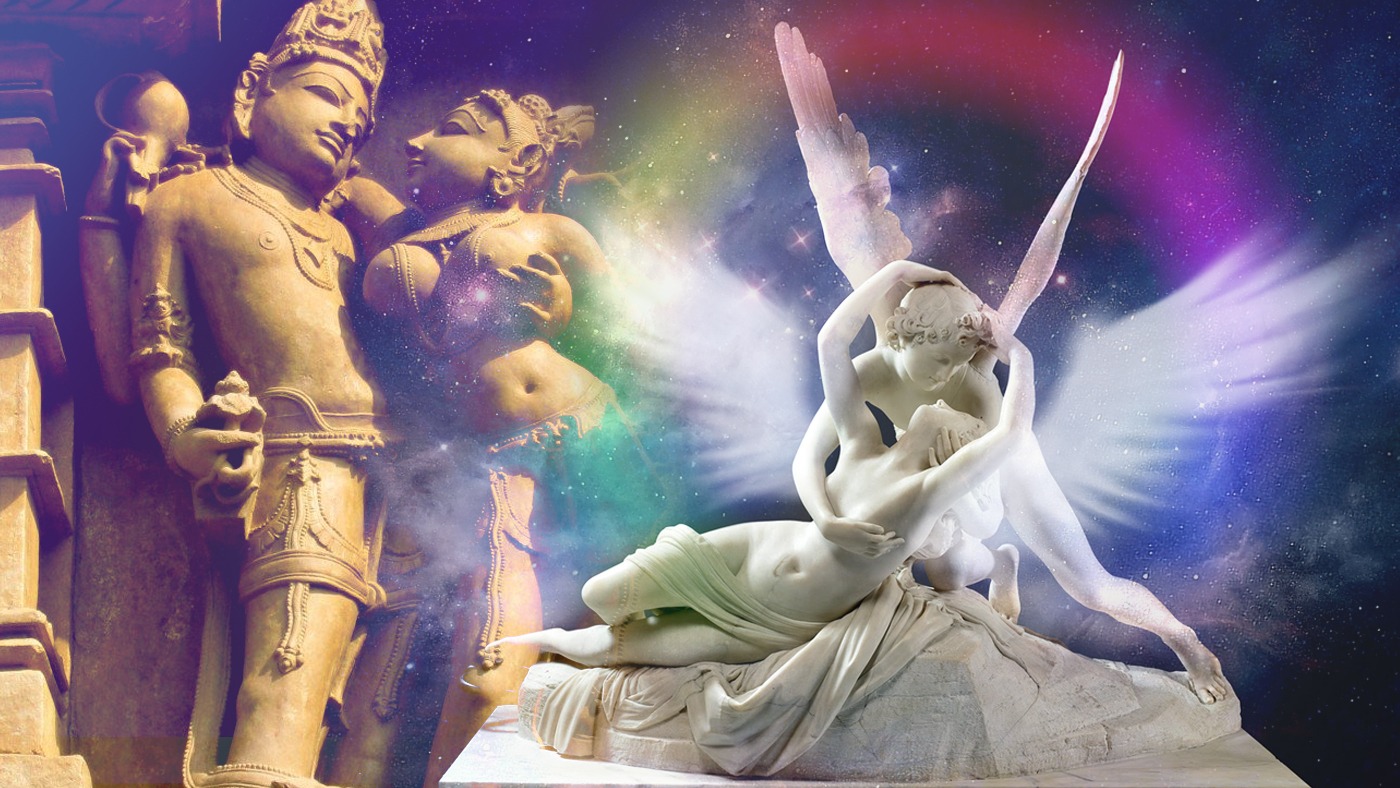
In Plato’s Symposium, Eros is described as a movement that can elevate the human being from physical attraction toward higher forms of beauty and understanding. In certain currents of Indian Tantra Yoga, sexual energy is refined and sublimated, which allows the awakening of Pure Eros as a superior state.
So the idea that Pure Eros can be more than sexuality is not new.
What is more specific in Bivolaru’s teaching is the clarity with which this process is approached. The emphasis on continence, on the accumulation of energy, on transfiguration, on the combination of Pure Eros with love, and on the refinement of experience—these are not abstract ideas, but something that can be verified in practice.
For example, the claim that intimacy can continue for hours without discharge, while deepening in intensity and awareness, is not presented as theory. It is something that practitioners are invited to explore directly.
This is where the teaching becomes concrete. And it is also where it is most often misunderstood.
From the outside, these ideas are easily interpreted through familiar assumptions. Everything is reduced to sexuality. Terms are flattened. The distinction between instinctual sexuality and consciously awakened Pure Eros disappears.
This is what we often see in podcasts and documentaries. Certain elements are presented, but the framework that gives them meaning is left out. What remains is a simplified image that does not reflect what is actually taught.
If one wants to criticize, it should be based on what is really there.
But to see what is really there, one has to begin with a simple distinction: sexuality is not Eros. What is taught here is not the cultivation of sexuality, but the awakening of Pure Eros—as an energy, as a lived state, and as a way of being in life.